This page provides general editorial information, not legal advice. Rules, service terms and distributor policies can change. Ask a qualified adviser about a specific release, contract or dispute.
Keep three different questions separate
First, does the service give you contractual permission for the intended use? Second, what copyright protection, if any, applies to your contributions and the resulting work in the relevant jurisdiction? Third, could the material infringe somebody else’s rights? These questions overlap but are not interchangeable. A plan labelled “commercial” may answer part of the first question without resolving the other two. Do not turn a marketing label into a promise of originality, exclusive ownership or worldwide clearance.
Read the terms that apply to your account, the tool and the date of creation. Look for restrictions on commercial use, attribution, sublicensing, redistribution, voice features and uploaded material. A later subscription upgrade may not change permissions for outputs created earlier. Preserve the relevant terms and purchase records, but avoid assuming a screenshot replaces the complete contract. If a clause is unclear, seek clarification before committing a track to a campaign, library or exclusive agreement.
Legal starting points: the U.S. Copyright Office’s AI resources, the UK Intellectual Property Office, and WIPO’s frontier technologies resources. These provide jurisdiction-specific or international context, not a single global clearance rule.
Audit the inputs as carefully as the output
List every uploaded recording, lyric, sample, melody and voice reference. Owning a copy of a recording is not the same as holding permission to submit it to an online service. A collaborator’s performance may also be subject to an agreement that limits processing, sharing or model training. Ask what the service retains and whether it uses uploads to improve models. If you cannot explain your authority to use an input, pause the workflow rather than hoping the final result conceals it.
Voice work deserves explicit discussion. Consent to record a session is not necessarily consent to clone or transform a singer’s voice, and rights relating to identity or publicity vary by jurisdiction. Agree on permitted uses, duration, compensation, access and deletion where relevant. Avoid presenting a generated performance as a real person’s participation. Even where a tool permits an operation, your contractual obligations and the affected person’s rights may create additional limits.
Document the human work without overstating it
Keep a factual account of what you wrote, performed, selected, arranged and edited. Preserve drafts and project versions where practical. This record may help explain authorship and collaboration, but it does not guarantee copyright protection. The amount and character of human contribution matter differently across legal systems. Do not describe a generated passage as entirely human-composed merely because it was selected from several options. Be precise about the actual process and avoid unsupported ownership claims.
For UK music administration, PRS for Music and PPL address different rights and roles. An ISRC identifies a recording; an ISWC identifies a musical work. An identifier is not proof that every underlying right has been cleared.
Agree credits and splits before delivery
Discuss songwriting, production and performance contributions with collaborators while the decisions are still fresh. Tool use does not erase the need for a split agreement, nor does software automatically become a contractual collaborator. Record agreed names, roles and percentages where appropriate, and confirm who can authorise distribution. If a label, client or library requires disclosure of AI assistance, answer accurately. Check the actual agreement rather than guessing that disclosure is always required or never relevant.
Review the distributor’s current rules, including any requirements concerning synthetic voices, misleading metadata, rights evidence and prohibited content. Platform acceptance is not a legal opinion and does not prevent later claims. Listen for recognisable borrowed material, but do not treat your own listening or an automated similarity check as conclusive clearance. If something sounds unusually close to a known recording or melody, investigate it and obtain advice when the stakes justify it.
Build a release folder another person can follow
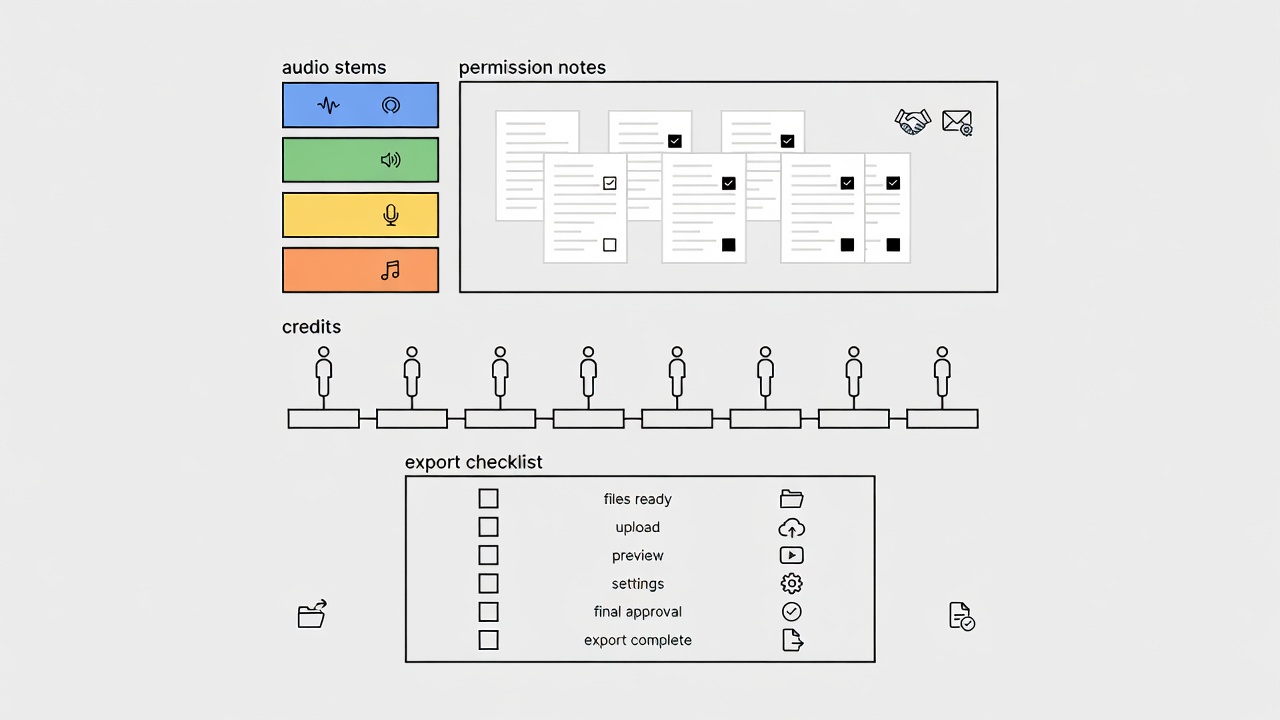
Include the approved master, version label, credits, contributor agreements, source and sample licences, generation notes, relevant service terms and delivery requirements. Keep sensitive agreements private rather than embedding them in public metadata. Make a short index that explains which document supports which use. A tidy folder reduces confusion when a collaborator, distributor or client asks a specific question months later.
The final decision may be to release, revise, replace a questionable part or hold the track. None of these outcomes is a failure of creativity. A reliable production practice leaves room for an unresolved rights question to change the musical plan. If a generated element cannot be responsibly used, a newly performed substitute may preserve the idea while making the release path clearer.